Y2K Game: Grandia II
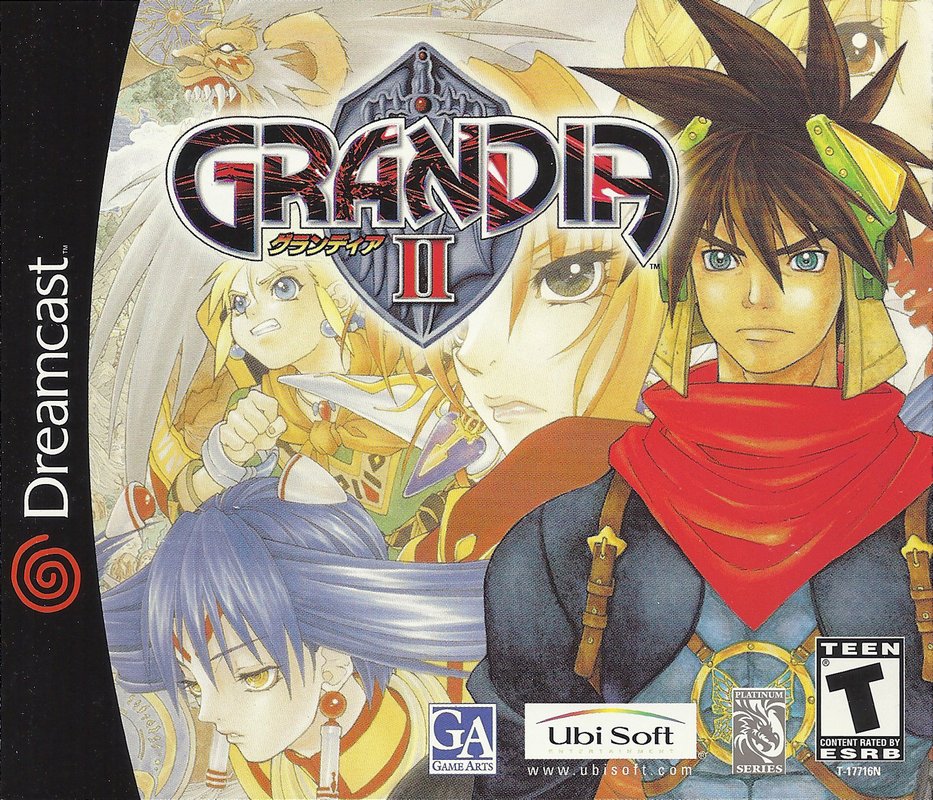
Grandia II

My adventure into turn-based RPGs continues. I've already played Super Mario RPG, Clair Obscur: Expedition 33, Chrono Trigger, and Evolution 1 & 2. Of those, Chrono Trigger is the best by a massive margin and the only one I'd even replay. The others are decent, but none of them turned me into a believer of turn-based combat. Grandia II, on the other hand, did exactly that. I would even go as far as saying that the combat in Grandia II is superior to Chrono Trigger's. It loses in every other area, but it wins in that one matter. I didn't know what to expect from Grandia II, but for the most part, it surpassed my expectations. There's one glaring flaw that makes me hesitant to replay it in the future, but aside from that, it's a very fun game that I can easily recommend, especially if you're into the genre.
Exquisite Combat
The combat system is very well thought out. I've praised Chrono Trigger's Active Time Battle system before. Grandia II's battle system shares similarities with it, but is also radically different. The one thing they have in common is a charge meter. However, Grandia features a meter with multiple stages. It begins with a waiting stage, then a command stage, and finally an act stage. During waiting stage, you wait your turn while others play theirs out. Once the command stage kicks in, the menu opens and you must decide your actions while the everything else pauses. Once you select your action, you enter the act stage. During this stage, your character charges up and carries out the command you just issued.
IP Gauge
The charge meter in this combat system is called the IP gauge. Each character has an icon that slowly moves from left to right and your character's stage is determined by where that icon is the gauge. The speed of this icon depends on attributes such as speed, agility, and move. So, just like the active time battle system, it's not a simple back-and-forth exchange. It's entirely possible for one character to complete four turns while the other only takes three, for example. That's cool on its own, but the depth comes from how different attacks interact with different parts of an opponent’s gauge. If you strike during an opponent's act stage with a critical hit, it cancels their attack and resets their gauge to about halfway. If you manage to strike just as an opponent’s act stage is about to end during their own attack, the hit will land with a counterattack multiplier. Moreover, each characters icon moves at different speeds depending whether it's in the wait or act stage.

Tactics
But these are just the basic attacks. Each character also has the option to use special moves that consume special points. These types of moves can either unleash a powerful attack for more damage, boost a character's stats, or heal. Some of these special attacks also have the cancellation effect discussed earlier. In addition, Magic attacks can also be selected once the player unlocks the mana eggs by progressing through the story. These magic attacks consume magic points and can also inflict greater damage, boost stats, reduce an opponent's stats, heal, or revive allies. There are also area and line attacks that will damage any enemy caught within a radius or corridor. Now you must consider not only when to strike, but whether it's worth it to alter stats, heal, perform an area strike, try to cancel an attack, or score a big counterattack. It's a very deep system that keeps you tactically engaged in every battle and that's what I love so much about it.
Unlikely Heroes
You begin as Ryudo, a sword-for-hire known as a Geohound. He’s a rude, crude dude who’s only interested in his own personal gain. It’s amusing how offended he gets when people stereotype him for being a Geohound, selfish, money-driven, and only out for himself, while he spends most of his time acting exactly that way. He’s not cruel or evil; he’s just a self-interested bastard. Full disclosure: I’m not necessarily opposed to that worldview. However, Ryudo does take it too far when he neglects to help people in need.
Sword for Hire
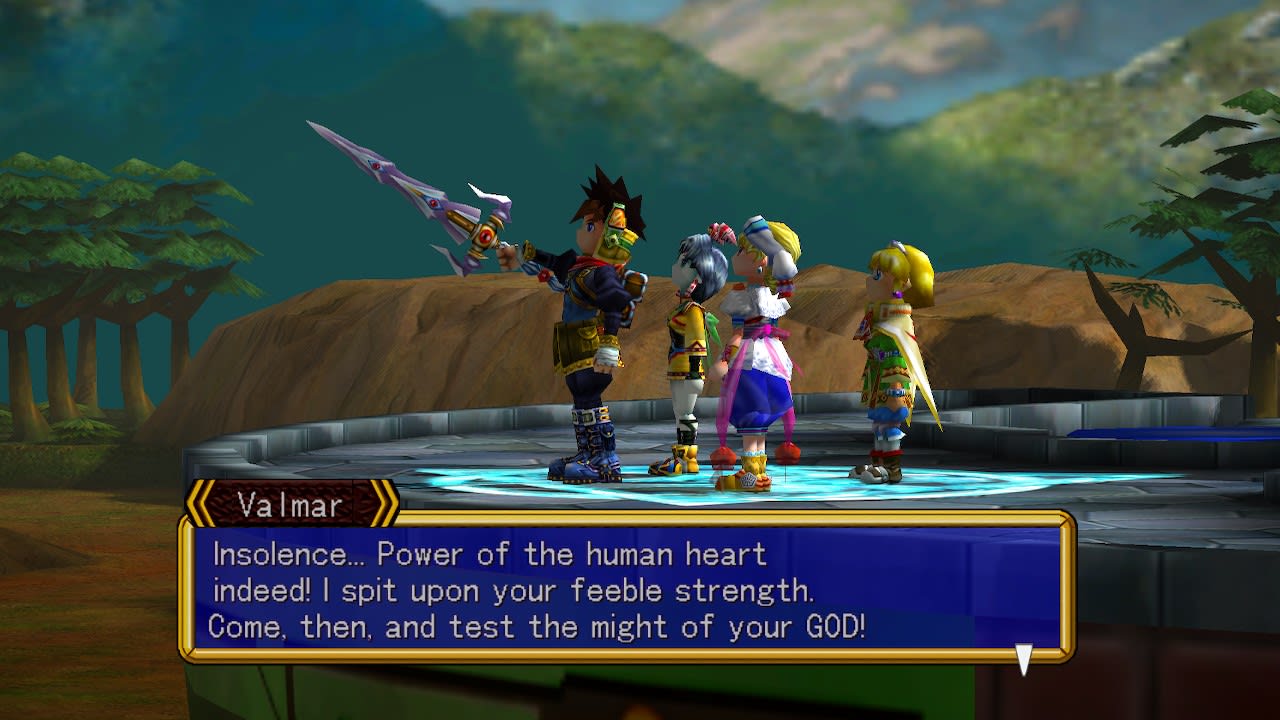
Luckily, Elena becomes his first party member and is able to nudge him towards helping people out, even if those in need have to pay some coin. Elena is also a focal point of the story as Ryudo's first job is to escort her to a temple where a ceremony to seal dark magic must be performed. The ceremony goes horribly wrong and darkness escapes, spreading throughout the world. It even partially possesses Elena and causes her to temporarily transform into Millenia, the wings of the dark god Valmar. It then becomes Ryudo's mission to escort Elena all the way to the Cathedral so that Pope Zera can dispel, or at least help.

Companions
The cast of companions grows as they continue their adventure; each with their own objectives. Mareg, for instance, is on a quest to exact revenge on the evil man that destroyed his village. Roan starts off as a wimpy but determined and curious kid (he's fourteen) that is later revealed to play a pivotal role. We encounter Millenia early on and soon learn she partially possesses Elena. This split between the two characters creates an amusing dichotomy of a naive religious girl and a dark possessed selfish lady. We are later introduced to Tio, an android who first discovers free will, and then discovers the strength of the human heart.
Thematic Story
The story contains maybe one or two twists, but it's your typcal JRPG affair with a gang of unlikely heroes set off on a quest to save the world and take down the supreme bad guys. Undoubtedly, the most insteresting one is Ryudo's and Roan's stories. Both of then reveal themselves suddenly and add a flavorful twist to the usal RPG affair. Both of them contain themes of not being haunted by your past and that redemption is always available. But you must not shy from, but rather assume responsibility and control of your own life. I also thought Tio's transformation from obedient robot to sentient being was charming. There's also something to be said about how the villains in this story, and even some of the minor characters, give in to the dark god out of lust for power, hopelessness, or distrust of their neighbors. It's not what I would call monumental, but I find it's very well done and kept me properly engaged and motivated throughout.
Detractions
I do have some issues with this game. The camera can provide awkward views during battle, especially when multiple attacks are being launched all at once. During exploration, if there's a tall tree or building, the rotating camera can get stuck behind it. This doesn't happen nearly enough to be a detraction, but it is present. Another complaint I have is that some of the magic and special attack animations, though cinematic and cool, are too long for my taste. I also thought the cut-scenes and dialogue took too much of my time as I played through.
Worst Flaw
My biggest detraction with Grandia II is just the sheer length. I clocked in about fourty hours and I felt like it should have been over by a little over the thirtieth one. There is a surprising twist that occurs when you return to Pope Zera and his servant Selene. I actually liked the twist, but I would have been completely satisfied if the final boss battle occurred and ended the game right then and there. Instead, you must complete another series of dungeons, several minibosses before finally squaring up against the dark god....only to discover that you still have to fight the final form of the dark god but only after beating a series of bosses right before that. It should have ended sooner. It aggravated me enough to potentially even deter me from future playthroughs.
Great Despite Flaws
Despite all its flaws, Grandia II ranks as one of the best games on the Dreamcast. That console didn't have much in the way of RPGs, which is unfortunate, because it clearly had potential. I've yet to play Skies of Arcadia. That game along with Grandia II are routinely ranked as the two best RPGs and among the top ten games on the Dreamcast. So, I I'll definitely pick that up at some point. Playing games like Grandia II, Record of Lodoss War, Rez, and Metropolis Street Racer remind me how many hidden gems are on the Dreamcast and much potential it had. I would have loved to see more games like Record of Lodoss War or Rez.


Comments
Post a Comment